
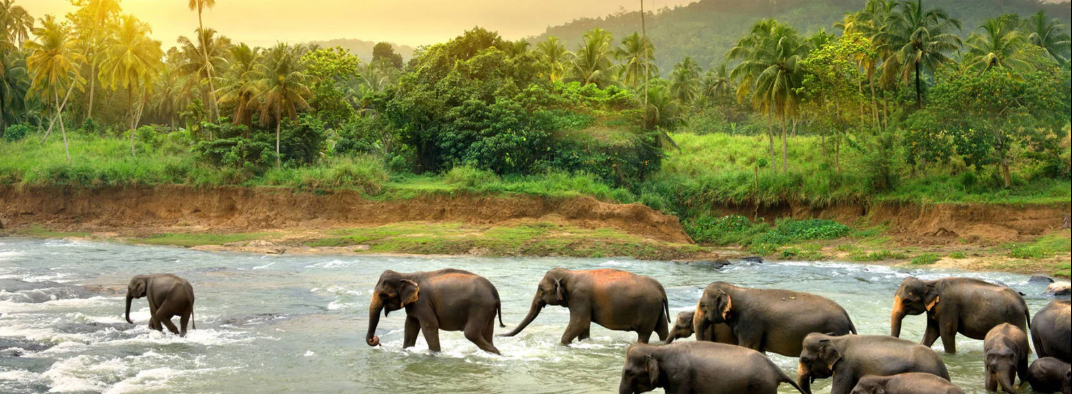
Pinnawala Elephant Orphanage sits in the low-country hills of Kegalle District, roughly midway between Colombo and Kandy, and holds what is widely regarded as the largest captive herd of Asian elephants in the world. Founded in 1975 on a 25-acre coconut estate alongside the Maha Oya River, it began as a rescue centre for orphaned and injured wild elephants and has since grown into a breeding programme with well over 90 elephants of varying ages. For many visitors on the Colombo–Kandy corridor, it is the first close encounter with Sri Lanka's most iconic animal.
History and Background
The story of Pinnawala starts not in Kegalle but at Wilpattu National Park, where the Sri Lanka Department of Wildlife Conservation established a small holding facility in 1972 to care for calves found abandoned or injured in the jungle. Three years later, in 1975, the growing herd was relocated to the present site — a coconut smallholding adjoining the Maha Oya — where the river could serve as a natural bathing ground and the land could support a larger population. In 1978 administrative responsibility shifted from the Wildlife Department to the National Zoological Gardens of Sri Lanka.
The most significant development came in 1982 with the launch of a captive breeding programme, the first of its kind in Sri Lanka. Asian elephant reproduction in captivity is notoriously difficult; the programme's success — more than 20 calves born here, many of whom have now produced calves of their own — has made Pinnawala a reference point in elephant conservation literature. The herd today includes animals ranging from days-old calves to bulls in their fifties, and several multi-generational family units can be identified by regular visitors and researchers.
What You Will See and Do
The River Bath
Twice daily the entire herd is walked approximately 500 metres down the main road to the Maha Oya for a supervised bath. This is the centrepiece of any visit. Mahouts guide the elephants into the river and the animals wallow, spray water, roll, and socialise in a manner that is genuinely engaging to watch. The procession through the village — a column of elephants of all sizes moving along an ordinary road past small shops and guesthouses — is in itself an extraordinary sight. Bath times are typically 10:00–12:00 and 14:00–16:00, though the precise schedule can shift slightly depending on feeding routines and season. Arriving 15 minutes before the herd moves gives you time to position yourself on the riverside viewing banks without being caught in the crowds that accumulate once the elephants are already in the water.
Feeding and the Nursery Area
Inside the main compound, calves under three years old are bottle-fed by mahouts at regular intervals throughout the day — typically every two hours from early morning. The sight of a very young elephant drinking from an oversized bottle is undeniably compelling, and this area tends to attract the densest concentration of visitors. Each elephant in the herd receives roughly 76 kg of green matter daily — primarily grass, leaves, and coconut palm — supplemented by approximately 2 kg of a dried mixture containing rice bran and maize. Feeding demonstrations are informal rather than timed performances; if you are patient and stay in the compound between bath sessions, you will observe feeding naturally.
The Compound and Observation
The orphanage grounds are set among mature coconut palms with a network of shaded observation paths. Elephants are tethered or enclosed in various sections depending on temperament, age, and whether a female is nursing. The arrangement is more open than a conventional zoo but less free-ranging than a wildlife sanctuary. Visitors can observe chained individuals at fairly close quarters, which raises legitimate welfare questions that any honest guide should acknowledge (see the Honest Notes section below). The overall atmosphere is that of a working facility rather than a polished wildlife park: there is mud, the smell of dung, and the noise of a very large animal population — all of which contribute to its authenticity.
Location and How to Get There
Pinnawala village lies in Kegalle District, approximately 90 km northeast of Colombo and 40 km west of Kandy. The orphanage entrance is within the village itself.
By Train
The nearest railway station is Rambukkana, roughly 2 km from Pinnawala. Trains on the Colombo Fort–Kandy main line stop at Rambukkana; the journey from Colombo Fort takes approximately 1 hour 45 minutes on an intercity express and up to 2 hours 30 minutes on slower services. From Rambukkana station, three-wheelers cover the remaining distance in around 10 minutes for roughly LKR 200–350. This is the most economical and often the most comfortable option from either city.
By Bus
Buses on the Colombo–Kandy route (A1 road) stop at Kegalle, from where local buses or three-wheelers continue to Pinnawala. Direct buses from Kandy to Kegalle run frequently and take around 1 hour. From the A1 highway, the turn-off to Pinnawala is at approximately the 82 km marker near Kegalle town.
By Private Vehicle or Tuk-Tuk
Hiring a driver for the day from Colombo or Kandy allows you to combine Pinnawala with other sights along the corridor (see Nearby Sights below). Journey time from Colombo is 2–2.5 hours depending on traffic; from Kandy, approximately 1 hour. Parking is available near the entrance. Note that the road into the village narrows considerably and can become congested when tour coaches arrive.
Tickets and Opening Hours
The orphanage is open daily from 08:30 to 17:30. Ticket prices are set by the National Zoological Gardens and have been subject to periodic revision; as of 2024, foreign adult admission is in the range of USD 15–20 (approximately LKR 4,500–6,000 at current rates). Children under 12 are charged a reduced rate, typically around half the adult price. Sri Lankan nationals pay a significantly lower tariff — in the region of LKR 100–200. Tickets are purchased at the main gate; there is no online booking system. The entrance fee covers access to the compound and the river bathing viewing area.
A note on value: the admission price has risen sharply over recent years and some visitors feel it no longer reflects the relatively modest facilities. Budget accordingly, and arrive early enough to see both a feeding session and a bath to make the most of the ticket cost.
What to Bring and Etiquette
Footwear: Closed shoes or sandals with grip. The riverbank and parts of the compound are muddy and slippery year-round.
Sun protection: The riverside viewing area is largely unshaded. A hat and sunscreen are essential from March to October.
Cash: The ticket booth and refreshment stalls operate cash only. An ATM is available in Kegalle town, not at the orphanage.
Camera: Photography is freely permitted throughout. A longer lens (70–200 mm equivalent) is useful for river shots from the bank.
Behaviour: Do not attempt to touch elephants outside designated interaction areas. Avoid loud noises near young calves. Keep a respectful distance from bulls, which can behave unpredictably. Follow mahout instructions without hesitation.
Food: Bringing food to feed elephants is discouraged and rangers will intervene. Items sold at the gate (bananas, sugarcane) are the sanctioned option if you wish to participate in feeding.
Accessibility
The main compound has a reasonably flat gravel path suitable for wheelchairs with assistance, though the surface is uneven in places. The riverside viewing bank involves a gentle slope and some uneven ground near the water's edge. There are basic toilet facilities at the entrance and near the river viewing area. No formal accessibility provision exists for visitors with significant mobility impairments, and the crowds during peak hours can make navigation difficult regardless of physical ability.
Honest Notes
Animal Welfare Considerations
Pinnawala occupies an ambiguous position in contemporary elephant welfare discussions. Defenders point to its conservation and breeding achievements and to the genuine rescue work it performs for orphaned calves that would not survive in the wild. Critics note that adult elephants spend significant portions of the day chained, that the conditions fall well short of what welfare-focused sanctuaries such as those at Udawalawe afford to elephants in semi-wild environments, and that the elephant-riding experiences offered by some adjacent guesthouses (outside the official orphanage) involve training methods that are considered inhumane by most wildlife organisations. The official orphanage itself does not offer riding. Visitors should make their own informed decision and decline any third-party offering involving riding or direct physical contact with captive animals outside the orphanage grounds.
Commercial Pressure
The road into the village is lined with souvenir shops, restaurants, and guesthouses, many of which are owned by families with a financial interest in extending your visit. Some have upstairs terraces with views of the river that they advertise as free — these invariably come with significant pressure to eat or drink. The official riverside viewing area inside the orphanage ticket boundary is perfectly adequate; you do not need to pay for a restaurant table to see the bath. Be polite but firm if approached by touts outside the gate offering "better views".
What to Skip
If you have already visited Udawalawe National Park, where elephants roam freely in a natural reserve and can be observed from open-sided jeeps, Pinnawala may feel like a disappointing comparison. The two experiences are fundamentally different: Udawalawe offers genuine wildlife observation while Pinnawala offers close-range access to habituated animals in a managed setting. Neither is a substitute for the other, but travellers prioritising wild behaviour over proximity should visit Udawalawe first.
Nearby Sights to Combine
Pinnawala's position on the Colombo–Kandy axis makes it natural to combine with either city's wider attractions. Kandy, 40 km northeast, warrants at least a full day in its own right for the Temple of the Tooth, the lake, and the surrounding hills. In the opposite direction, the Makandawa Rainforest near Kithulgala offers a sharp contrast — a primary forest with white-water rafting on the Kelani River, roughly 25 km south of Pinnawala. The Dambulla Cave Temple and Sigiriya are feasible on the same day only if you have a private vehicle and an early start; for most itineraries it is more sensible to treat the Cultural Triangle as a separate base, centred on Habarana or Dambulla. Travellers heading south from Kandy towards the hill country can incorporate the Bluefield Tea Gardens before descending to Nuwara Eliya or Ella.
Practical Summary
Address: Pinnawala village, Kegalle District — approximately 90 km from Colombo on the A1 corridor
Opening hours: 08:30–17:30 daily
Admission (foreign visitors): approximately USD 15–20 / LKR 4,500–6,000 (adult); half price for children under 12
Bath times: approximately 10:00–12:00 and 14:00–16:00
Recommended duration: 2.5–3.5 hours to see both a feeding session and one bath
Nearest train station: Rambukkana (2 km; three-wheeler to orphanage)
Best visiting time: Weekday mornings, September–October for fewest crowds