
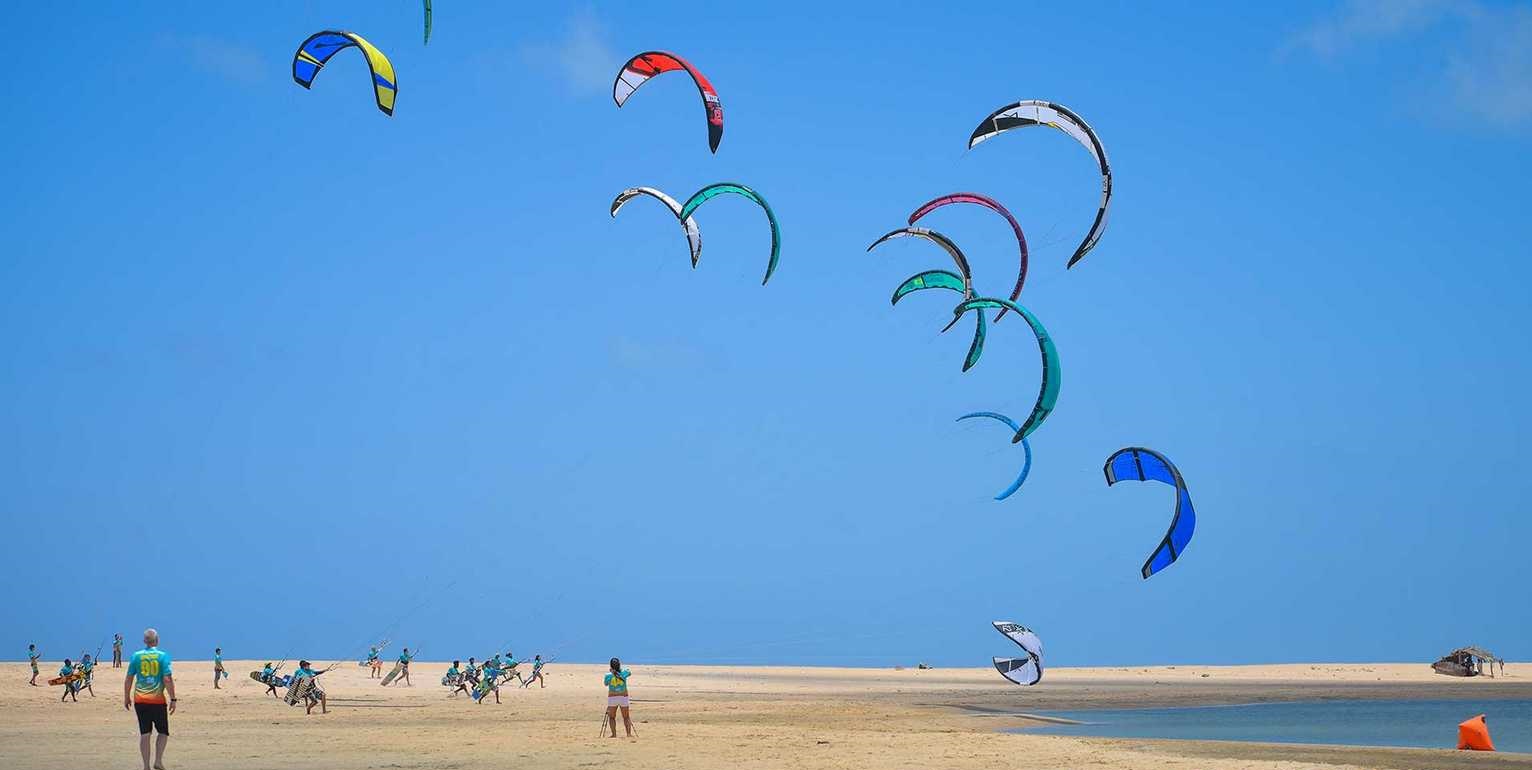
Kalpitiya juts into the Indian Ocean roughly 160 km north of Colombo, separating the open sea from the shallow, island-dotted waters of Puttalam Lagoon. The peninsula is narrow enough that you can see water on both sides from a bicycle, and the contrast between the lagoon's calm surface and the ocean's rolling swell defines everything about the place — its ecology, its activities, and its mood.
From around November through April, the south-west trade wind drops and a reliable north-east wind takes over, sustaining speeds that kitesurfers and windsurfers travel considerable distances to find. The lagoon's flat water makes it particularly suited to beginners learning to control a kite, while the ocean side offers longer runs for experienced riders. Several small schools and camps have grown up along the foreshore without, so far, overwhelming the landscape.
The same seasonal window brings spinner dolphins close to shore in extraordinary numbers. Pods of several hundred — occasionally over a thousand individuals — are regularly encountered on morning boat trips departing from the small fishing harbour. These are not curated encounters; the dolphins are wild, fast-moving, and frequently aerial. A local boat operator and a patient eye are all that is required.
The Lagoon and Its Islands
Puttalam Lagoon is fringed by a scatter of small islands — collectively part of the Bar Reef Marine Sanctuary, one of Sri Lanka's largest coral reef systems. Snorkelling and diving here reveal hard and soft corals alongside a broad range of reef fish, though the sanctuary's condition varies by zone and season. The lagoon itself supports dense mangrove stands that shelter juvenile fish, wading birds, and occasional dugong sightings — rare, but documented.
A Quiet Kind of Place
Kalpitiya has none of the infrastructure of Unawatuna or Mirissa. The village is a working fishing settlement; the guesthouses are small; the roads are long and mostly flat. That relative emptiness is the appeal. Sunsets here — watched from the lagoon side as the sky goes through several shades of copper over still water — have a particular quality that is difficult to manufacture elsewhere.
The area also borders the Wilpattu National Park buffer zone to the south-east, and the scrub forests along the peninsula's inland edge hold their own modest wildlife: land monitors, a range of waterbirds, and, after dark, an improbable density of stars above a coast with almost no light pollution.
What makes a visit to Kalpitiya memorable is rarely a single moment — it tends to accumulate: the spray from a dolphin pod at dawn, the clean pull of a kite in steady wind, the silence of a mangrove channel at low tide, and the particular stillness that settles over the lagoon as the fishing boats come in.
Kalpitiya Dolphin & Whale Watching Safari
A boat trip out of Kalpitiya's lagoon into the open Palk Bay brings you face to face with some of the largest spinner-dolphin superpods in the Indian Ocean.
Kalpitiya's "safari" takes place on water rather than on a dirt track. The peninsula sits at the edge of the Palk Bay, where deep offshore channels and warm, nutrient-rich currents attract spinner dolphins in numbers that regularly run into the hundreds — occasionally into the thousands. Between November and April, when the north-east monsoon has passed and the sea flattens out, these superpods surface close enough that you can hear them exhale. Sperm whales and blue whales have also been recorded in the deeper water beyond the bar, making a full-day excursion genuinely worthwhile.
Vessel Types
Local operators use two main craft. A fibreglass speedboat (typically seating six to ten passengers) gets you to the pods quickly and allows repositioning as the dolphins move — useful when you're tracking a fast-travelling group. A traditional wooden oruwa (outrigger), by contrast, runs quietly and disturbs the animals less, though it is slower and better suited to calm conditions. Responsible guides keep a respectful distance and do not drive into the centre of a pod.
Half-Day vs Full-Day
Half-Day (around 3–4 hours)
Departures are usually at sunrise, when spinner dolphins are most active near the surface. The boat moves roughly 10–20 km offshore, locates a pod, and returns before midday heat sets in. This format suits those who are also kitesurfing or combining the trip with a visit to the nearby Bar Reef Marine Sanctuary in the afternoon.
Full-Day (6–8 hours)
A longer excursion pushes further into open water, increasing the chance of encountering blue whales or sperm whales, which appear more reliably in January and February. Packed lunch and drinking water are typically provided. Bring high-SPF sun protection — there is no shade on the water.
What a Typical Trip Looks Like
The boat clears the lagoon channel and heads north-west into the Palk Bay. Within thirty to sixty minutes, the guide scans for surface disturbance and the characteristic arching leap of spinner dolphins. Once a pod is located, the engine is cut and the boat drifts alongside. Spinners are curious animals and will often approach voluntarily. After observing for a period, the boat repositions or, on a full-day trip, continues further offshore. Return is timed to avoid the stronger afternoon chop that builds on most days between December and March.
Seasonality
November to April — prime season; calm seas, reliable pod sightings.
January and February — peak months for blue whale and sperm whale encounters offshore.
May to October — south-west monsoon brings rough seas; most boat operators suspend departures.
Practical Notes
Book through a licensed operator; unregulated boats sometimes harass pods at close range.
Life jackets should be provided as standard — confirm this before boarding.
Motion-sickness tablets are advisable if you are susceptible; the open bay can be choppy even in the dry season.
A telephoto lens of 200 mm or longer is worth carrying; dolphins surface unpredictably and distance varies.
Most departures leave from the small jetty near Kalpitiya town or from resorts on the peninsula's western shore.
For a guided dolphin-watching excursion or a combined marine-safari itinerary, Lakpura can arrange transfers, boat bookings, and accommodation on the peninsula through a single point of contact.