
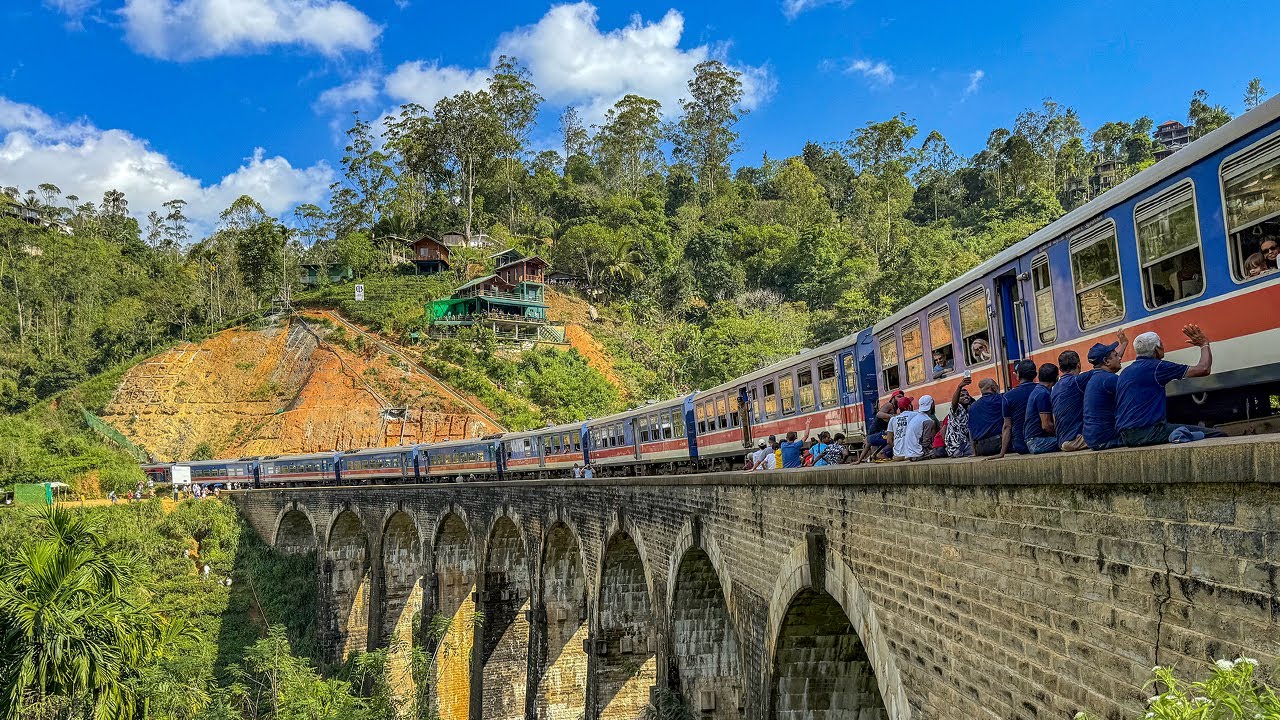
Ella is a small hill town in Sri Lanka's Uva Province, sitting at roughly 1,040 metres above sea level on the southern escarpment of the Central Highlands. It punches well above its size: a single main street, a handful of parallel lanes, and a surrounding landscape of tea-draped ridges, jungle waterfalls, and a celebrated railway line that draws travellers from across the island — and the world. The pace is slow, the air genuinely cool, and the views through Ella Gap — a dramatic cleft in the ridge that frames a vertiginous drop to the southern plains — are among the most arresting in the country.
History and Character
Ella's modern identity is inseparable from the British colonial plantation economy. The surrounding highlands were cleared for coffee in the mid-nineteenth century, then replanted with tea after coffee blight swept through the 1870s, and the infrastructure built to service those estates — the railway above all — became the town's greatest tourist asset a century and a half later. The town itself remained a quiet transit point until the early 2000s, when backpacker culture latched onto its combination of cool temperatures, affordable guesthouses, and walkable terrain. Growth since has been rapid; the main drag, Ella Road (locally called the high street), is now lined with cafés, rooftop bars, and souvenir shops. That commercial density is real and worth noting: Ella today is undeniably touristy, particularly in peak season, and travellers seeking untouched tranquillity should calibrate expectations accordingly. What it offers in return is a genuinely well-organised base for highland exploration, excellent trail access, and one of the most beautiful train rides on earth arriving or departing at its doorstep.
Orientation and Neighbourhoods
Ella is compact enough to walk end-to-end in twenty minutes. Orientation is straightforward.
Main Street (Ella Road): The commercial spine running roughly north–south through the centre. Restaurants, pharmacies, ATMs, minimarkets, and tour-desk offices are concentrated here. It gets noisy on weekend evenings.
Passara Road area: Branching east from the main junction, this quieter corridor has mid-range guesthouses and a slightly more local character. Good for early-morning views over the gap.
Ella–Wellawaya Road corridor: The road descending south-west toward Wellawaya (approximately 21 km) passes Ravana Falls and several budget lodges popular with hikers. Noisier from traffic but close to the falls trailhead.
Tea estate lanes above the town: A network of unpaved tracks winds through working estates above 1,200 m. Several guesthouses sit within the plantations here — quieter, colder at night, and rewarding if you have a tuk-tuk or scooter.
Key Sights and Experiences
Nine Arch Bridge (Demodara Bridge)
The Nine Arch Bridge, built in 1921 from brick and local stone, spans a jungle valley about 1.5 km from the town centre on foot. It is one of Sri Lanka's most photographed railway structures. The bridge is best viewed from the jungle path below — reach it via the lane behind the Ella railway station, then follow the footpath downhill (15–20 minutes). Trains cross several times daily; the two most popular are the morning departure toward Kandy (around 07:00–08:00) and the afternoon service. Check the Sri Lanka Railways schedule on arrival because timings shift seasonally. Arriving crowds at peak hours (09:00–11:00) can be substantial; the 06:30 walk is quieter and the light is better.
Little Adam's Peak
A 3.5 km return hike from the trailhead near the 98 Acres estate (accessible by tuk-tuk from the centre, roughly LKR 300–500), Little Adam's Peak rises to about 1,141 m and offers panoramic views across tea country and the Ella Gap escarpment. The ascent takes 45–60 minutes on a well-maintained path. The peak is genuinely crowded by mid-morning during high season; a 06:00 start rewards both solitude and dramatic low-cloud conditions. Entrance is free; the path crosses private estate land, and small gratuities to estate workers who assist on the route are customary but not obligatory.
Ella Rock
A more demanding and more rewarding hike than Little Adam's Peak, Ella Rock (approximately 1,392 m) requires 4–5 hours return and involves navigating railway tracks, plantation paths, and a final steep scramble. Most walkers start from the railway station and follow the tracks toward Demodara before cutting uphill — a local guide (LKR 1,500–2,500) is useful because the upper path is poorly signed. The summit is frequently cloud-free in the early morning and wraps in mist by mid-afternoon. Take water and sun protection; the exposed upper section offers no shade.
Ravana Falls
Around 6 km south of Ella on the Wellawaya road, Ravana Falls drops approximately 82–90 metres over a basalt cliff face in a single curtain. The viewing area is right off the road, and a concrete staircase leads to a lower pool — though the pool itself is generally not safe for swimming during or after rain, when flash flooding is a real risk. The nearby Ravana Ella Cave complex has archaeological significance: fossils attributed to Homo sapiens balangodensis (Balangoda Man) were excavated in the vicinity, offering evidence of prehistoric human habitation in the highlands. Tuk-tuk from Ella centre: LKR 400–600 one way; the falls see the highest crowds between 10:00 and 14:00.
The Train Journey
The railway between Ella and Kandy (approximately 5.5–6 hours) is routinely cited as one of the most scenic train rides in the world, and the accolade is warranted. The route climbs through tea estates, crosses the Nine Arch Bridge and dozens of smaller viaducts, and passes through Nanu Oya (for Nuwara Eliya), Hatton, and Peradeniya Junction before reaching Kandy. First-class observation cars must be reserved in advance through Sri Lanka Railways — demand far outstrips supply, especially December to March; book 30 days out if possible. Second-class unreserved seats are available on the day and the experience, if cramped, retains the same views. The journey from Ella to Kandy departs early morning; the reverse direction arrives in Ella in the afternoon.
Tea Plantation Walks
The estates surrounding Ella — including the slopes above the town toward Poonagala — are open to walkers on informal paths. Walking directly into working sections during plucking hours (typically 06:00–14:00) is possible but requires courtesy. Some estates offer informal factory visits where you can observe withering, rolling, and drying processes without charge or for a small donation. This is a more authentic alternative to the heavily commercialised factory tours found further north toward Nuwara Eliya.
Food and Drink
Ella's culinary scene is disproportionately good for a town its size, driven partly by the concentration of experienced travellers who have raised the bar over time.
Rice and curry: The local staple, best sought in smaller family-run spots away from the main street. Expect LKR 350–700 for a full rice and curry with multiple accompaniments; garden-fresh vegetables — green beans, leeks, pumpkin — are a regional highlight.
Kottu roti: The highland version is less oily than coastal preparations. Most short-eat shops on Passara Road serve it until around 21:00.
Rooftop cafés: Predominantly Israeli- and Western-influenced menus (shakshuka, granola, pasta) reflecting Ella's backpacker heritage. Prices are higher than average for Sri Lanka: USD 4–8 per main course at mid-range rooftop establishments.
Fresh produce: The small market near the bus stop sells avocados, passion fruit, and strawberries grown nearby — all considerably cheaper than the same items in Colombo or Galle.
Tea: Uva-grown tea, characterised by a bright, slightly astringent flavour, is the regional style. Most guesthouses serve it; estate shops along the Wellawaya road sell loose-leaf in sealed packets (LKR 300–800 for 100g of reasonable quality).
Alcohol is served in most tourist-facing restaurants; local arrack is cheaper than imported spirits. Friday and Saturday evenings the main-street bars get loud; if that is not your preference, estate-area lodges are noticeably quieter.
Where to Stay
Accommodation splits broadly into three tiers and three zones.
Budget guesthouses (USD 10–25/night): Concentrated on Passara Road and the lanes off the main street. Basic but clean; most include breakfast. Quality varies; look at the mattress and hot-water reliability before committing.
Mid-range lodges (USD 30–80/night): The sweet spot for most travellers. Several sit within tea estate land above the centre, offering unobstructed valley views and relative quiet. Access usually requires a tuk-tuk; factor that in if you plan late-night town excursions.
Boutique and higher-end properties (USD 100–250+/night): A small number of well-designed properties occupy ridge positions with infinity-edge pools overlooking the escarpment. Standards are high; availability is tight in peak season and advance booking (2–4 weeks) is advisable.
Staying within the plantation lanes rather than on the main street meaningfully improves sleep quality and morning atmosphere. Note that hot water supply is patchy at the budget level — Ella nights drop to 14–17 °C even in dry season, so confirm before checking in.
Getting There and Getting Around
By Train
The most scenic and most recommended approach. Trains connect Ella to Kandy (5.5–6 hours, first-class LKR 1,100–1,500, second-class LKR 400–600) and to Colombo via the hill line (8–9 hours). The route from Ella continues south-east to Badulla, the line's terminus, in approximately 45 minutes — Badulla is a useful connection for onward bus travel south.
By Bus
Intercity buses connect Ella to Wellawaya (30 minutes), Badulla (1 hour), and Nuwara Eliya (2.5–3 hours). From Wellawaya, connections serve Udawalawe National Park (approximately 1 hour further) and the southern coast. Buses are cheap (LKR 50–300 for regional legs) but infrequent after 18:00.
By Road
Private taxis and app-based services (PickMe operates in the region) connect Ella to Colombo in roughly 5–6 hours depending on route, and to Galle in approximately 3.5–4.5 hours via Wellawaya and the A2. Scooter hire is available locally (LKR 1,500–2,500/day); the mountain roads reward two wheels but require confident riding — the Ella–Wellawaya descent in particular is steep and sharp-cornered.
Within Ella
The town centre is walkable. Tuk-tuks handle all trailhead transfers; negotiate the fare before boarding (LKR 200–600 for most local destinations). There is no metered system.
Practical Tips
Money: Two commercial bank ATMs operate on the main street (BOC and Sampath); both accept international cards but have daily withdrawal limits (typically LKR 20,000–40,000 per transaction). Carry some cash for guesthouses and tuk-tuks; card acceptance is improving but patchy.
Connectivity: Dialog and Airtel both offer 4G coverage across most of central Ella and the main hiking trails. Signal drops in the deep plantation lanes. SIM cards with data are best purchased in Colombo or Kandy.
Safety: Ella is generally safe. The primary hazards are trail-related: paths to Ella Rock become slippery after rain, and the railway-track sections of the Ella Rock and Nine Arch Bridge routes carry live trains — walk single-file, listen, and stand well clear. Do not sit on the bridge for photographs as trains approach; several serious accidents have occurred at this site.
Scams: The most common involve informal guides who attach themselves to walkers on the main street and quote fees only at the destination. Agree on any guiding arrangement and its price before departing.
Altitude and temperature: Nights are cool year-round (14–18 °C); a mid-layer and a light waterproof are practical regardless of season. Early-morning hikes at Ella Rock can feel genuinely cold.
Etiquette: Many estates have Hindu kovils and small Buddhist temples on their land. Remove footwear before entering any temple; dress modestly (knees and shoulders covered) when visiting religious sites or walking through villages.
Suggested Itineraries
One Day
Rise at 06:00 and walk to the Nine Arch Bridge for the morning train crossing. Return to town for breakfast, then take a tuk-tuk to the Little Adam's Peak trailhead by 09:00 and complete the hike before midday heat. Afternoon: tuk-tuk to Ravana Falls; explore the viewing area and walk up toward the cave site. Return to town for a rice and curry dinner on Passara Road.
Two Days
Day one as above. Day two: an early start for the Ella Rock hike (depart by 06:30 with a guide from the station); allow 4–5 hours return. Afternoon at leisure — visit a tea factory on the estate lanes above town, or simply read on a guesthouse terrace. Evening: explore the main street food options.
Three Days
Days one and two as above. Day three: take the morning train toward Kandy, disembarking at Nanu Oya for a day in the Nuwara Eliya area before returning by evening bus, or continue all the way to Kandy as an onward journey. Alternatively, arrange a full-day transfer south to Udawalawe National Park for a morning safari before continuing to the coast.
Day Trips from Ella
Badulla: 45 minutes by train, the Uva Province capital has a modest market, the Muthiyangana Raja Maha Vihara temple, and the Dunhinda Falls (5 km from town, 64 m drop) — less visited than Ravana Falls and more dramatic in wet conditions.
Udawalawe National Park: Approximately 1.5–2 hours by road via Wellawaya. Sri Lanka's premier elephant-watching destination, with a resident population of several hundred. A morning safari and return to Ella in the same day is feasible with an early 05:30 departure.
Haputale: 30 minutes west by train, this quieter ridge town has the Lipton's Seat viewpoint (arguably more dramatic than Little Adam's Peak on a clear day) and the Dambatenne Tea Factory — the historic estate established by Sir Thomas Lipton in 1890 and still operational.
Arugam Bay: Around 3 hours by road via Wellawaya and Monaragala, Sri Lanka's premier surf break on the east coast makes for a logical onward destination rather than a day trip, but the journey is achievable in a single transfer for those ready to move on from the highlands.